
Summer Springboard
Electrical Engineering
ON THE CAMPUS OF GEORGETOWN UNIVERSITY

COMBINE ELECTRICITY AND MECHANICS TO CREATE THE FUTURE.
Electrical Engineering
- Hands-on exploration of circuits, sensors, and microcontrollers.
- Use of professional engineering tools like multimeters and Arduinos.
- Team-based challenges that mirror real-world problem-solving.
- Off-campus experiences at the Smithsonian and a cutting-edge Robotics Laboratory in Washington, DC.
- Culminating capstone project showcasing creativity and technical skills.
Summer Springboard
Electrical Engineering


About This Course
An engineering program for teens on a university campus in Washington, D.C.
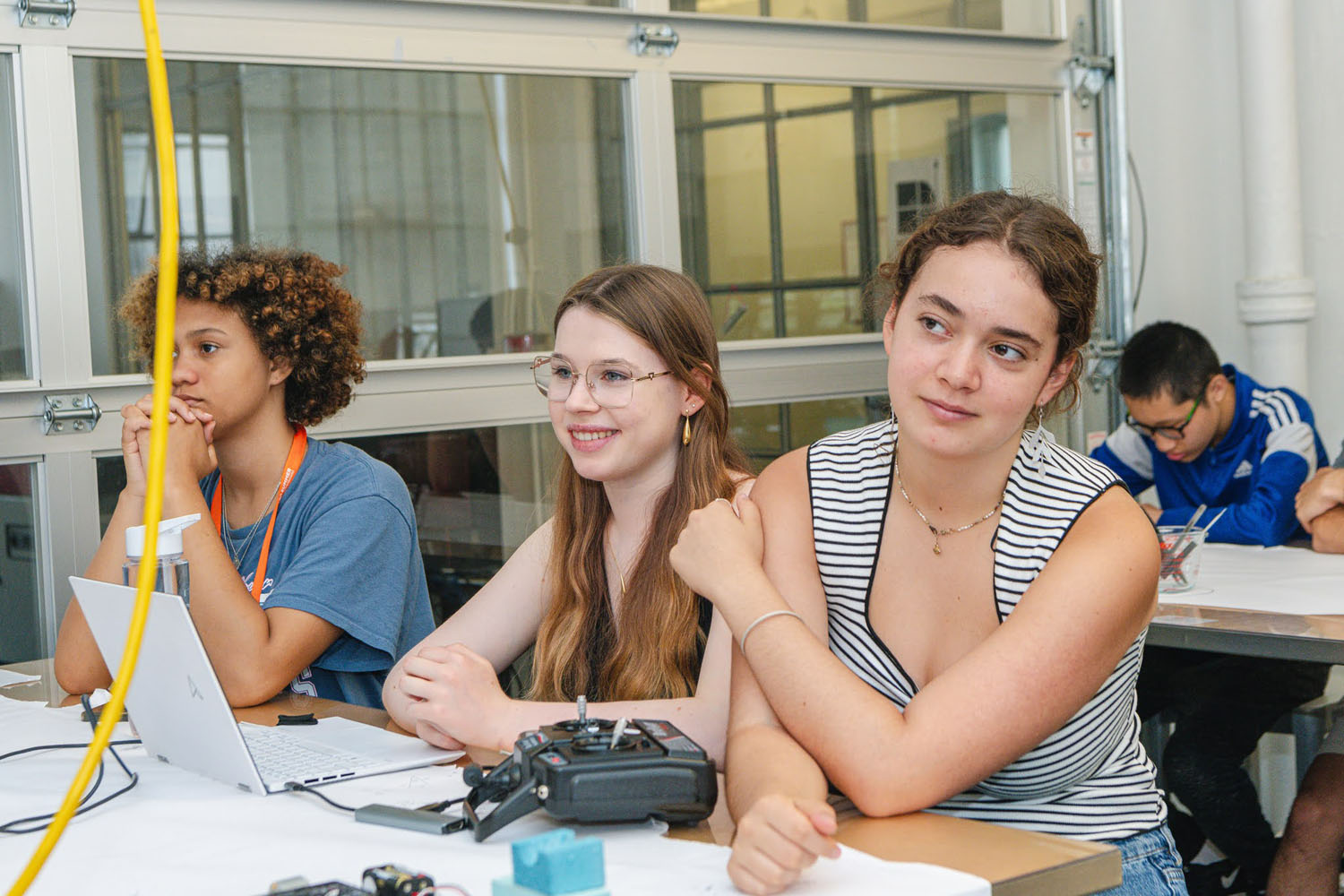
As mechatronics grows increasingly important in technology and industry, students often face a choice between electrical and mechanical engineering, this course brings them together. The Electrical Engineering program introduces high school students to the principles of both disciplines, providing a hands-on foundation in circuits, sensors, and mechanical systems. Learners explore how electricity and mechanics work in tandem to create interactive devices, from programmable sensors to motorized models.
Through collaborative projects, creative experiments, and guided problem-solving, students gain practical experience turning ideas into functional prototypes. Off-campus experiences at the Smithsonian and a cutting-edge Robotics Laboratory in Washington, DC highlight real-world engineering innovations and show how electrical and mechanical systems combine in today’s technologies. The course concludes with a capstone project, allowing students to apply their skills and showcase their understanding of mechatronics and electrical engineering.
TOPICS YOU'LL EXPLORE
Hands-on Learning
Career Exploration
Students participate in off-campus experiences at top institutions, including the Smithsonian and cutting-edge robotics laboratories, providing a rare opportunity to see engineering innovations in action. From early electronics to modern autonomous machines, these visits show how electrical and mechanical systems come together in real-world applications.
During previous summers, students visited the engineering department at George Washington University and explored its advanced robotics lab. They interacted with a variety of robotic technologies, including a robotic dog capable of performing multiple tasks and engaged in verbal interactions and games with the robot, gaining firsthand experience with human-robot collaboration.
RESOURCES
Course Infosheet
Click here to view or download the printable infosheet for this course.
Program Catalog
Click here to request our catalog to learn more about our summer programs and courses.
Campus Page
Click here to view the website page for this campus and learn more.
“It was good experience. It had a good balance between academic courses and non-academic activities. It introduced real world problems and events to let the student take into consideration when choosing their major.”
-Noah B. | Alumni Student
Summer Springboard
Electrical Engineering
Meet Your Instructor
Ekundayo Shittu is a Professor in the Department of Engineering Management and Systems Engineering at GW’s School of Engineering and Applied Science. He directs the Systems Modeling Laboratory for Economic Decisions (SysMoLED), where he collaborates with students and researchers to analyze the strategic interaction between firms’ technology investments and the external environment using mathematical programming, transaction cost economics, and the resource-based view. He co-edited Renewable Energy: International Perspectives on Sustainability (Springer) and holds two patents for improving patient safety through condition-based maintenance of biomedical assets. He is a member of the U.S. National Committee for the International Institute for Applied Systems Analysis under the U.S. National Academies and serves as an Assistant Editor for Applied Energy, a leading journal in the field. A Fellow of the Kern Entrepreneurial Engineering Network (KEEN), he has spent the past six years leading four-week summer intensive spreadsheet modeling workshops for high school students (Grades 9–12) to foster interest in STEM, particularly engineering. He holds a B.Eng. in Electrical Engineering from the University of Ilorin, Nigeria; an M.S. in Industrial Engineering from the American University in Cairo, Egypt; and a Ph.D. in Industrial Engineering and Operations Research from the University of Massachusetts Amherst, U.S.
EKUNDAYO SHITTU

“I really enjoyed it, I thought it was good mix of academics and activities and I really was able to connect with people especially in the free time so having that as an option was great. I thought it was a great mix and intro to college life which was very helpful.”
-Addy M. | Alumni Student
Summer Springboard
Electrical Engineering
Dates & Tuition

| 2026 Dates |
|---|
| Session 1: June 21 – July 3, 2026 |
Click here to enroll in this course using our online enrollment form.
| Tuition |
|---|
| Residential Tuition: $5,798 |
| Commuter Tuition: $2,998 |
| Course Supplement: $250 |
Tuition Protection Plan: Allows for cancellation for any reason up until the day of the program.
| Location |
|---|
| City: Georgetown Neighborhood |
| State: Washington, D.C. |
| Campus: Georgetown University |
Summer Springboard programs are not run by our campus partners (with the exception of Cal Poly, UW Foster and NYSID which are run in partnership with SSB). Universities and their affiliated departments and partners do not control and are not responsible or liable in any manner for any part of the Summer Springboard program.